
Tower Garden Plastic Explained: What Is Tower Garden Plastic Made Of?
First, if you are thinking about growing food with a Tower Garden, one of the most reasonable questions to ask is simple: what is Tower Garden plastic made of?
After all, this is a system designed to grow lettuce, herbs, tomatoes, peppers, cucumbers, squash, flowers, and more. So the material matters. You want something durable, food-safe, opaque, and engineered for indoor and outdoor growing conditions.
In this guide, I’ll explain the basic material Tower Garden uses, why opacity matters, how it compares to ordinary agricultural plastic, and why the durability of the tower is such a major part of the value.
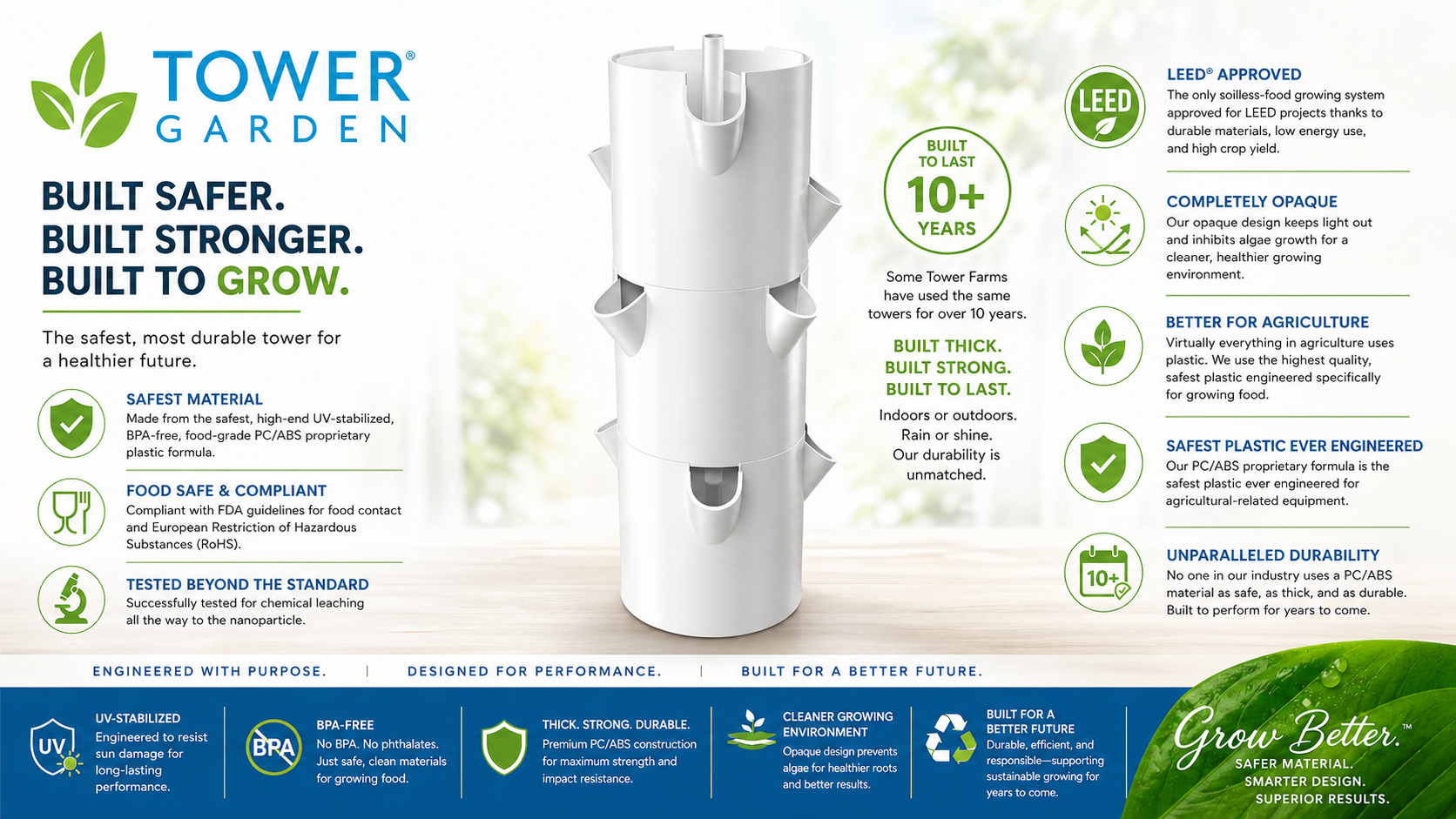
Tower Garden plastic is made from a proprietary PC/ABS material, which refers to a blend built around polycarbonate and acrylonitrile butadiene styrene. The point is not merely that it is “plastic,” but that it is a thicker, more durable, UV-stabilized, BPA-free, food-grade material designed for agricultural use.


What Is Tower Garden Plastic Made Of?
The short answer is that Tower Garden uses a proprietary PC/ABS plastic formula. The better answer is that the tower material is designed around food safety, strength, opacity, UV resistance, and long-term use.
First, Tower Garden is not made from thin, cheap, throwaway plastic. The tower body is made from a proprietary PC/ABS formula, which is a high-end plastic blend used because it can offer strength, impact resistance, and durability.
In simple terms, Tower Garden plastic is designed to be strong enough for repeated growing cycles, outdoor sunlight, indoor farms, water movement, nutrient solution, plant roots, and daily use.
PC/ABS combines qualities associated with polycarbonate and ABS. For a growing system, that matters because the tower needs to hold its shape, resist damage, handle moisture, and perform consistently over time.
That is one reason the material discussion should not be reduced to “plastic is plastic.” In agriculture, the quality, thickness, opacity, durability, and intended use of the plastic make a major difference.
- Main keyword: what is Tower Garden plastic made of?
- Short answer: proprietary UV-stabilized, BPA-free, food-grade PC/ABS
- Why it matters: durability, food contact, opacity, and long-term growing use

Next, Tower Garden’s material is described as BPA-free and food-grade, using high-quality resins selected for food-growing applications. That is important because the tower is not just a decorative planter. It is part of a system that circulates water and nutrients around edible plants.
Tower Garden’s material is described as compliant with U.S. food-contact expectations and European restrictions related to hazardous substances. That does not mean every growing method is identical, but it does mean the tower is manufactured with food-growing use in mind.
For anyone asking, “what is Tower Garden plastic made of?” the answer should include more than the name of the plastic blend. The more relevant point is that the material is engineered for a food production environment.
- BPA-free: designed without BPA
- Food-grade: intended for food-growing applications
- Resin quality: selected for agricultural equipment use

Moreover, one of the most practical features of the Tower Garden material is opacity. In hydroponic and aeroponic systems, light entering the water or nutrient area can encourage algae growth.
A good growing system should protect the root and nutrient environment. Since Tower Garden’s material is opaque, it helps keep light out of the internal growing area, which can reduce the conditions that encourage algae.
This is one of those details that sounds small until you actually grow hydroponically. Light control, water movement, oxygen, nutrients, and cleanliness all matter.
- Problem: light can encourage algae in wet growing environments
- Material advantage: opaque plastic helps keep light out
- Grower benefit: cleaner, more manageable system conditions

Then, durability is one of the biggest reasons Tower Garden’s material matters. A tower may be used indoors under grow lights, outdoors in the sun, in a backyard, on a patio, in a school, or even inside a larger indoor farming setup.
Because the material is UV-stabilized, it is designed with outdoor exposure in mind. That is a major difference between a serious growing system and a flimsy container that starts breaking down after a season or two.
Some Tower Farms have reportedly used the same towers for many years, and that matters. When a tower lasts through repeated growing cycles, the material becomes part of the long-term value of the system.
Instead of buying a lightweight system that may need to be replaced quickly, Tower Garden is designed as more of a durable growing platform. That is especially important for serious home growers, educators, restaurants, community projects, and small farm setups.
- Indoor use: works in controlled environments and grow-light setups
- Outdoor use: UV-stabilized material helps with sun exposure
- Long-term value: durability helps justify the investment


Additionally, it is worth being honest about modern agriculture. Soil-based farms, organic farms, hydroponic farms, and backyard gardens all use plastic in some form.
Nutrients are often stored in plastic containers. Irrigation lines and hoses are commonly petroleum-derived. Crops are often stored or transported in plastic. Even many organic systems rely heavily on plastic mulch.
The better question is not simply whether a growing system uses plastic. The better question is what kind of plastic it uses, how safe it is for its intended purpose, how long it lasts, and whether it reduces waste by avoiding frequent replacement.
In that context, a durable, thick, food-grade tower material can make far more sense than cheaper plastic products that crack, fade, leak, or end up being replaced repeatedly.
- Wrong question: “Is there plastic?”
- Better question: “What quality of plastic, and how long does it last?”
- Tower Garden angle: durable material built for repeated growing cycles

Finally, if you are asking what is Tower Garden plastic made of?, you are probably not just asking a chemistry question. You are asking whether the material is safe, durable, and worth trusting for food production.
My answer is that Tower Garden’s PC/ABS material is one of the reasons I take the system seriously. It is not the cheapest way to grow food vertically, but the material quality is part of what separates it from many lower-end hydroponic products.
Tower Garden makes the most sense for people who want a serious vertical growing system they can use repeatedly, indoors or outdoors, rather than a low-cost gadget they replace later.
It is especially useful if you want to grow food in a small footprint, teach kids, build a patio garden, start a hydroponic hobby, or expand food production without needing more land.
- Best for: home growers, educators, patio growers, indoor growers, small-space gardeners
- Main value: vertical food production with durable material
- Bonus: buy through my link and get my Tower Garden course free inside SKOOL

Want to Get a Tower Garden?
If you decide Tower Garden is the right system for you, you can use my Tower Garden buying link below. When you buy through my link, I’ll give you access to my free Tower Garden course on SKOOL, where I help you understand the setup, growing process, and how to get better results.
Also, if you want a deeper breakdown before buying, check out my full Tower Garden Buyers Guide. I built that guide to help people understand the system, compare options, and decide whether Tower Garden fits their growing goals.
Note: Tower Garden is a premium system, so I recommend reading the buyers guide first if you are still comparing hydroponic or aeroponic options.

Leave a Reply